
Below is a powerful piece, submitted to The Voices Project “Compassion” by Michael Chiacchia
“Sometimes you don’t hear the bullet”
I have been in some manner of medicine for over 30 years as of this writing. From volunteer Firefighting/EMS/Water Rescue, professional EMS, to my current role of Surgical Technologist, coming up on 20 years now at a local Buffalo hospital. It’s not an often thought of profession, usually people automatically think of nurses or therapists of some sort in the hospital setting, and we are used to that. It’s not the career path one chooses for the limelight, and that’s ok. Most of the time our patients that come ‘see’ us have been given some kind of sedatives when they ‘roll into the room’ and more than likely will not remember most, if any of our interaction. People usually envision a whole host of people in an operating room theatre from what they see on TV, quiet buzzing undertones of conversations going on while the surgeon and anesthesiologists seem to endlessly banter each other giving updates on the patient’s condition and surgical progress, and other ‘business chatter’ like that. Truth is, sometimes it’s only four of us to help that person, two doctors, a nurse, and myself. Not to alarm anyone, it’s usually a minor procedure, and that’s all we need to safely and properly care for that patient from start to finish. Much more urgent or larger scale surgeries will naturally have additional people involved as needed.
In my current experience, I have seen a lot in my time, from assisting in welcoming new life into the world all the way through being present at when someone’s heart beats its final beat. It’s never something I take lightly. I take a great deal of pride and professionalism in what I do. While we may seem to take a less than serious attitude on a surgery because we may have seen this surgery hundreds of times over, I remember that this may be someone’s very first surgical experience ever, is scared out of their wits, have no control over what is happening to them at this point, have no idea what is going on, all of this confusing ‘medical speak language’ they keep hearing, and could be thinking of what happens if they ‘never wake up’. Always very legitimate fears, and I try to always reassure every one of my patients that we will take absolutely wonderful care of them when they are asleep. It truly is the most trust one person can put in another person, since they are absolutely 100% helpless to protect themselves otherwise, and are trusting us to watch out for them and make sure everything goes well. From a simple procedure like taking out an inflamed appendix to major brain surgery, I reassure them that they will receive nothing less than my best care and attention they require. And tone of voice is critical, I will give them a legitimate tone of concern and compassion, a quiet reassurance that I’m not just going through the motions to move things along. Sometimes a patient is so scared, I’ve held their hand as they drift off to sleep. I have been told I’m ‘Old school’ because I will take my gloves off to hold their hand if it is practical and needed. I believe the gloves, while important for personal protection and safety when necessary (both myself and for the patient), but they tend to lack a certain human connection, takes away that cold clinical setting to reinforce my commitment to my promise to take excellent care of them. But if I don’t see a possible infection issue to either of us, and since I’ve already washed and sanitized my hands before I made initial contact as it is, I see no reason why a few minutes of skin-to-skin connection to truly reassure someone they are going to be watched over and protected. Sometimes it’s not practical, or if there are legitimate infection control issues that will require me wearing gloves, then I will. But they will still get my same professionalism regardless.
Unfortunately, there are sometimes when I can’t follow through on that promise. Not my fault, it’s just what happens. Always that blasted exception to that rule. This is one that has stuck with me. Hell, this was probably going on 10 years ago by now. We had an emergency exploratory abdominal surgery on a woman who had been having severe pain for several days, and after a surgical consult, it was determined that she needed urgent surgery to try to fix her. I remember the team wheeling her into the operating theatre, she was scared witless, almost panicked and near hysteria. My heart was breaking for her. She was just with her family just a few minutes before, and they had given each other a hasty goodbye. She was in pain. it was very evident. Her vital signs were low, so there was something going on in her abdomen. Bad. We needed to get in there and try to fix the problem most urgently. I remember we did have a few minutes of small talk while the anesthesiologist was getting his medication ready to put her to sleep. She spoke of her husband, and her son who was going to be starting college soon and was asking us how long we thought she would be needing to heal. We can’t really tell her definite timeframes without truly knowing what was going on, but we tell her it all depends on what we find when we get there. It calmed her down a little bit, which helps when anesthesia is putting her to sleep. But she was so scared, and she asked me if I would hold her hand while she went to sleep, which I happily did. She squeezed my hand so hard, I could tell she was beyond scared. So a few minutes of small talk to try to take her mind off the pain, at least a little bit, a promise for us to take excellent care of her, and the occasional bad joke to ease some tension, she finally goes to sleep, and we can begin her surgery.
Well, not all surgeries have the expected outcome. And we were not expecting what we did see. It was bad. Very very bad. This poor woman had been suffering for the past several days in pain, and when we got in there, we immediately found what was causing the problem. The worst thing we did not expect. She had gangrene in her organs. Stomach, Liver, intestines, pancreas, probably kidneys, literally most of her internal organs were dead, and there wasn’t anything we could do to fix it. Anything gangrenous needs to be removed from the body, or else it will cause further deterioration and other complications. We were amazed that despite her internal condition that we were seeing, she was still awake and able to talk to us before going to sleep. It normally is a condition that is not conducive to life, and we were amazed that she was still alive at this point, let alone talking to us. The surgeon, after a few minutes of exploring this poor woman’s abdomen to see the extent of the damage, only to realize that there was nothing short of a divine intervention that would have saved that woman’s life. The surgeon actually ‘broke scrub’ to go talk to the family and let them know what was going on, and basically tell them that there is nothing he can do to save her life unfortunately. He was with the family for a few minutes and came back to finish the surgery. He explained to this poor woman’s family that there was too much irreversible damage at that point, since removing all the damaged organs would ultimately still be fatal to her. All we could do is close the wound up and send her back up to the floor to let nature run its course and let her pass. At least we could allow her to pass from this life pain free and surrounded by her family.
She never did wake up. It was not medically possible to have her emerge from the anesthesia and breathing support. To do so would be not only medically unsound, but also inhumane due to her level of pain. She was going to die soon, regardless. I’m not God. Never tried to pretend I was. Don’t want to be God. There’s enough on God’s plate as it is. We finish closing her wound and clean her up. Sent her back upstairs still attached to the respirator, so her family could be around her to say their final good byes when the time comes. She was made comfort care, knowing it was only going to be a matter of a short time before she succumbs to her fatal condition. At least it can be done with a slight measure of control. With her family around when they removed the ventilator support. It still strikes me to this day that I was the last person on this Earth she talked with and had ‘person contact’ with before she drifted off to her final sleep. I’m forever thankful that I made it about her and reassuring her. I don’t think I could have done so otherwise. It’s such a harsh reminder that at any time, it could end up being our last time alive. I still carry that lesson with me to this day thankful I believe I did the right thing. I will always offer a hand of comfort or words of reassurance until I no longer can. I try to pass that wisdom onto future generations of surgical technologists. You don’t have to be a nurse to deliver great human care. And I will never apologize for ever being old school in my life. Kindness, compassion, and basic human decency, I think those should never go out of style.
Epilog: For those wondering what happened to this woman, I believe she suffered a blood clot in one of the main arteries supplying her organs, possibly the superior mesentery artery, causing her organs to end up going gangrenous. At the time, that was the most logical thing that could have happened, given the number of days that she was in pain. It’s very rare that something like this could happen, it’s the only time I’ve ever seen something like this. I don’t know what happened to her to cause it, it just was. Maybe if it was treated days sooner, it probably could have been reversed with medication, or who knows what else. Unfortunately, it was far too late at that point for her when we were trying to help her. And in case you were wondering why the odd title when there was no shooting, it is an homage to my favorite series, “M*A*S*H”, where a writer was ultimately killed because he was shot in a warzone, and there was no ‘ricochet noise’ of the bullet that killed him, and he didn’t hear the bullet. That episode left me with my other takeaway, and I paraphrase the final lesson often. “Rule #1, In a war, men die. Rule #2, doctors can’t change rule #1.”
Thank you for reading. Good night, and may God Bless.
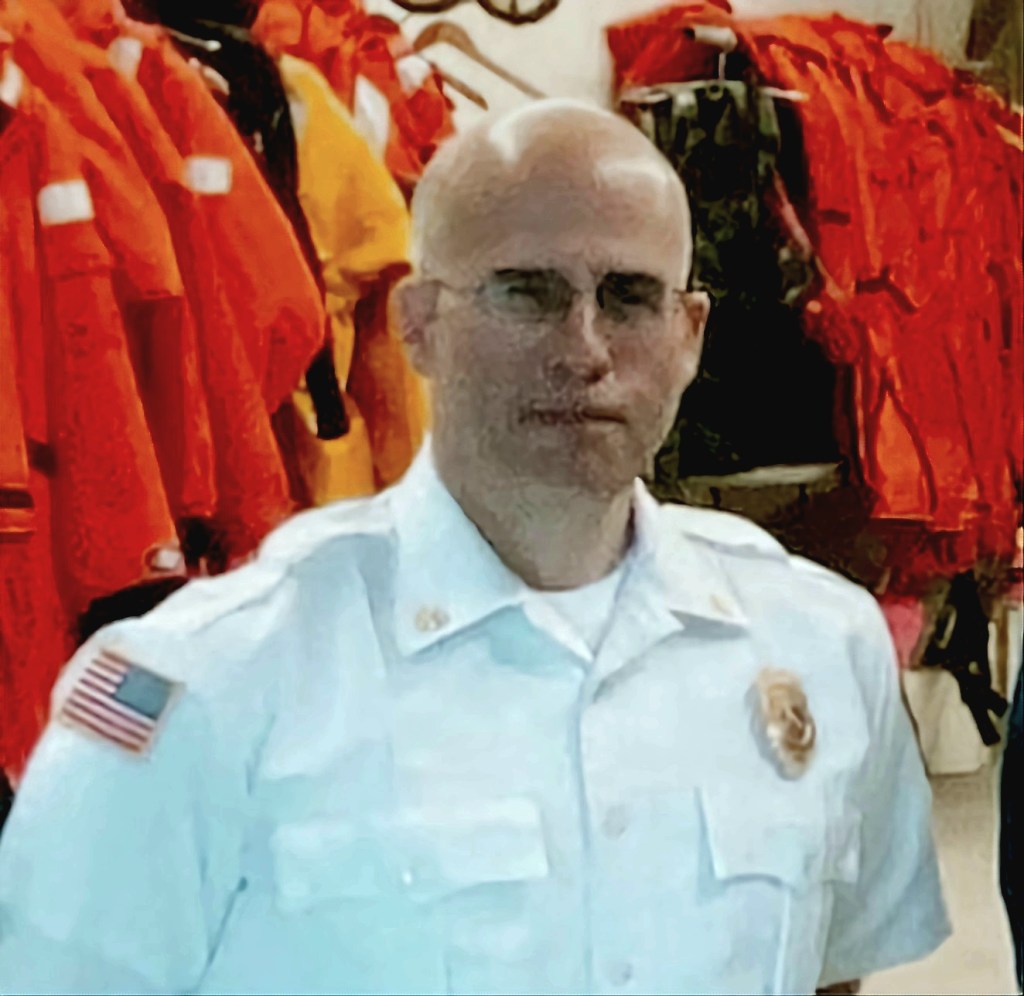
A little about Michael:
Michael has 3 grown children and 1 grand daughter as well as 3 dogs. He has been a volunteer firefighter and water rescue for 30+ years, a professional EMS for 15 years, and a Surgical Technologist approaching 20 years, with specialties including Orthopaedics, Neurosurgery, Urology, and General Surgery; currently employed at a large Buffalo, NY hospital. He currently lives in Hamburg, NY, is a volunteer with Buddy’s Second Chance Dog Rescue and his hobbies include cooking, wine making, home and auto repair and refurnishing.
Thank you for sharing your compassion story, Michael!
Submissions for the next Voices Project topic – Inspiration – are due by August 1, 2023. We hope you will consider submitting your art to us at inclusivetheaterofwny@gmail.com.

 The Voices Project